
Is it O.K to be a Luddite?
On Pynchon's question, forty-two years later
In October 1984, Thomas Pynchon — already by then a writer who had withdrawn from public life so completely that some reviewers wondered if he was a hoax — published an essay in The New York Times Book Review asking what now reads as one of the most prescient single questions of the late twentieth century. Is It O.K. to Be a Luddite?
The essay was occasioned by an anniversary. C. P. Snow had given his "Two Cultures" lecture at Cambridge in 1959; twenty-five years later, Snow was being remembered as the man who had warned the West that its intellectual life was splitting into two non-overlapping camps — literary and scientific — neither of which understood the other. Snow's most insulting line, the one that did not age well, was that literary intellectuals were "natural Luddites." He meant it as a diagnosis, not praise.
Pynchon picked the insult up off the floor and turned it over.
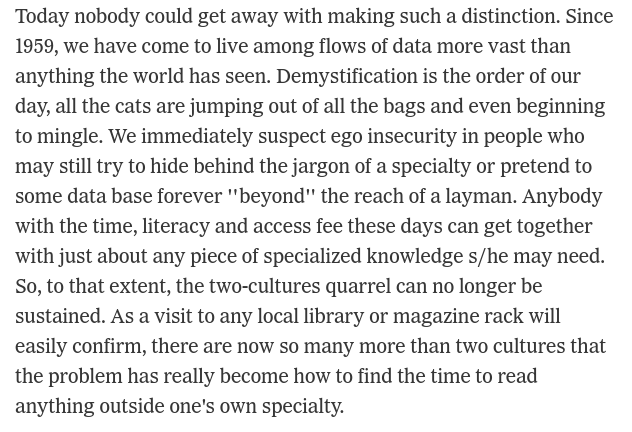
He began by noting, drily, that Snow's two-cultures problem had been solved by being overwhelmed. Since 1959, Pynchon wrote — and you can hear him counting on his fingers — "we have come to live among flows of data more vast than anything the world has seen." The cultures had not so much reconciled as multiplied. There were now too many cultures to count, and the new problem was finding the time to read across any of them. If you had access and literacy and a library card, no specialty was beyond you. The two-cultures quarrel was over because everyone had become a specialist in something and a tourist in everything else.
Then he asked his question — really three questions stacked on top of each other. Was there something about being a person who reads and thinks that pushed you toward Luddism? Was it O.K. to be a Luddite? And, while we were on the subject, what was a Luddite, anyway?
The body of the essay is a recovery operation. Pynchon was not interested in defending the cartoon Luddite — the brute who breaks machines because he is afraid of progress. He was interested in the actual Luddites of 1811-1816: the masked, organized, anonymous workers who walked into the textile mills at night and broke the specific stocking-frames that were destroying their specific livelihoods. Not a fear of machines. A precise quarrel with a particular arrangement.
Pynchon read them not as panicked machine-haters but as something closer to dedicated martial artists — practitioners of a focused, almost choreographed anger directed at very particular harms. He called them, in a phrase that has aged into a small monument, badasses. They knew the name of the mill owner. They knew which frame was the one. They went there at night with people they knew. They broke one machine and not another. Then they went home.
Forty-two years later, the question Pynchon ended his essay with has come due. He wrote — and I do not know any other twentieth-century sentence that has held up as well — that the next great challenge would arrive when the development curves of artificial intelligence, molecular biology, and robotics converged. He marked the moment with a small interjection of comic apprehension — the kind of noise a man makes when he knows he won't be around to see whether he was right.
He was off by about forty years. He is, possibly, still around to see it.
What I want to argue here — the third entry in this notebook, and the first that lets a writer other than Marx do the heavy lifting — is that Pynchon's recovered Luddite is the structural opposite of the third idiotēs I was describing in the last entry. They face the same situation: a transforming labor regime, a technological apparatus they did not design, a public being told to be grateful for the transformation. They respond differently, and the difference between their responses is the difference between two kinds of subject the modern moment makes available.
The third idiotēs responds by scrolling. They take in the new technology as one more piece of weather. They have opinions about it — they may even have many opinions, finely calibrated, performed for an audience. They will not act on any of them. They will not show up. They will not be present in the rooms where the technology's deployment is decided. They will, eventually, find themselves describing in past tense a transformation they neither approved nor opposed. Withdrawal by surplus.
The Luddite responds by showing up. Pynchon's Luddite is local, specific, embodied, and organized. He knows the name of the mill owner. He knows which frame is the one. He goes there at night with people he knows. He breaks that machine and not another. The Luddite is not anti-technology. The Luddite is the citizen of his moment — the person who insists that a transformation in the conditions of his life is a public question, not a private weather event, and that the answer is not to issue a take but to do something locatable.
Now hold those two figures next to each other and ask: which one is more recognizable as a social individual in Marx's sense?
The Luddite. Obviously the Luddite. The Luddite knows the chain. The Luddite knows where they are inside it. The Luddite has, in the older Greek register, come out of the private sphere and into the polis. The fact that we have been trained to laugh at him is part of the problem this notebook exists to describe.
I am not arguing that the present moment calls for actually breaking computers. Pynchon was not arguing that in 1984 either; the closing of his essay is conspicuously short on operational instructions. He gives the last word to Lord Byron, who wrote a song for the Luddites that begins, down with all kings but King Ludd, and leaves the reader to do what they will with it. What I am arguing is that the posture of the Luddite — the practice of showing up to a particular technological imposition with a particular response — is the gesture the third idiotēs has lost. And that recovering some version of it, rescaled for an age in which the relevant machine is not a stocking-frame in Nottinghamshire but a model weights file on someone else's server, is the political problem of the next decade.
This is harder than it sounds, because the relevant machine is on someone else's server. The Luddite of 1812 could find the building. The Luddite of 2026 has to find a hearing room, a procurement decision, a city council vote, a labor contract, a building permit for a data center, a workplace where the chatbot is being introduced as a productivity improvement, a school board agonizing over phones. The technology has dispersed; the politics has to disperse with it.
Snow called the literary intellectuals natural Luddites and meant it as proof they didn't matter. Pynchon looked at the same accusation and said: fine, then the literary intellectuals are the ones who can still see what the engineers can't afford to. I am inclined to extend this. Natural Luddite, in 2026, is what we should call anyone who insists on asking a public question about a private deployment. It is not a slur. It is not nostalgia. It is, increasingly, the only available form of presence.
Is it O.K. to be a Luddite? Pynchon's essay never quite answered the question — he was, characteristically, evasive. But forty-two years on, looking at the curves he predicted converging right now, on schedule, I think the answer is: it is not only O.K. It is, for anyone who would still like the social individual to show up at some point, the most coherent thing left to be.
link here: https://www.nytimes.com/1984/10/28/books/is-it-ok-to-be-a-luddite.html