
The Third Idiocy
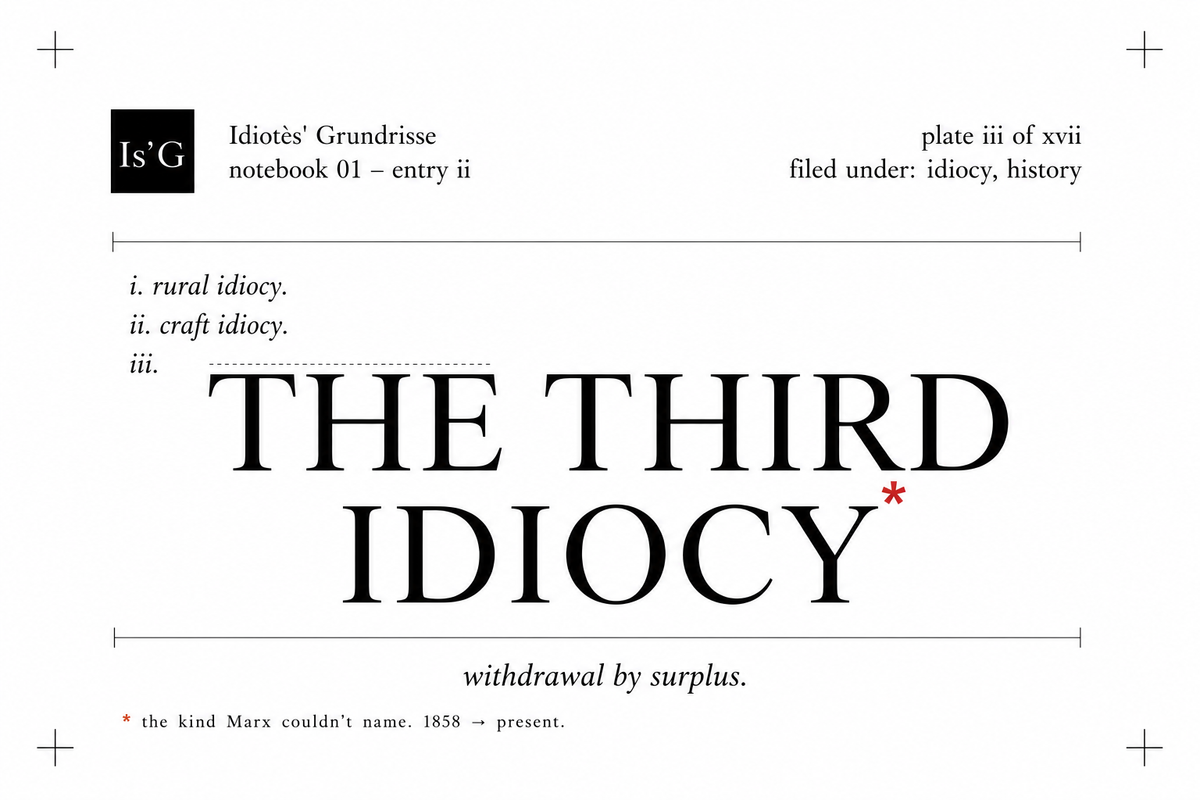
on the kind of withdrawal Marx couldn't have seen
Marx named two kinds of idiocy — and meant the word, in both cases, in its older Greek register. Idiotēs: the private one. The withdrawn. The person whose life happens away from the public arrangements that make a city a city.
The first kind was rural idiocy. The peasant on the small farm, embedded in seasonal time, rarely in contact with anyone outside the village or the market town. He produced for his own household, traded what he could, and operated on a scale where the wider organization of society was as remote as the weather. It was not stupidity. It was small horizon. The world ended at the next ridge.
The second kind was craft idiocy. The artisan in the workshop, embedded in trade time, knowing his guild and his suppliers and his three regular customers. He produced more sociably than the peasant did — there were apprentices, there were buyers, there was a journeyman who came through. But the frame of his life was still the workshop. The wider economy was something that arrived at his door when an order came in. The world ended at the trade.
Marx's bet — and you have to remember he was making it from the middle of the most disruptive decade of the nineteenth century — was that industrial capitalism would dissolve both. Not by being kind, but by being thorough. Mass production would force the peasant off the land and the artisan out of the workshop, drag both into factories where they would no longer produce for themselves but for an enormous chain of strangers, each of whom was producing for them in turn. They would, eventually, have to understand the chain. They would have to grasp themselves as nodes in a vast collective effort. They would, in a phrase he saved for his unfinished notebook, become social individuals.
I covered the failure of that promise in the first entry. The social individual didn't arrive. What arrived instead was the idiotēs with a feed.
But I want to be more precise about what kind of idiotēs that is, because the temptation — and I find it in myself when I try to write about this — is to assume the digital subject is just the rural or craft subject in new clothing. Same withdrawal, different scenery. Same private person, now with WiFi.
It isn't. It's a third thing.
Rural idiocy and craft idiocy were forms of under-connection. The peasant and the artisan were withdrawn because their material lives didn't put them in contact with the larger organization of the world. The remedy was supposed to be connection itself — pull them into the network and the rest would follow. The cure was contact.
The third idiocy is not under-connected. It is over-connected, in a degraded register. The contemporary subject is in contact with more people, more institutions, more arguments, more crises, more fragments of more cultures than any human in history. The flow of information into a single phone is, by orders of magnitude, larger than what a Roman emperor or a nineteenth-century newspaper editor had access to. By the standards of rural and craft idiocy, this person is a citizen of the world.
And yet. Look at what they do with it.
They follow people they will never meet. They form opinions they will never act on. They are aware of injustices they will never address. They read, every morning, dispatches from regions of the planet they will never see, written by reporters they will never thank, in languages they could not speak before machine translation. They participate in approximately none of the publics that the feed delivers them. They have, in essence, the polis in their pocket — and they use it the way the peasant used the village beyond the next ridge: as something distant, ambient, slightly hostile, mostly other people's problem.
This is the third idiocy. Withdrawal by surplus. The peasant was private because the world was small. The artisan was private because the trade was narrow. The contemporary subject is private because the input is overwhelming and the only sustainable response — for a body that has not been redesigned for this — is to skim, react, scroll, and forget.
You can describe this in clinical language (cognitive load, attention economics) or in moral language (atomization, doomscrolling, learned helplessness). The clinical and moral descriptions are both true and both miss the structural point: the third idiocy is what the Grundrisse's social individual looks like under inversion. All the conditions Marx prophesied — universal access to accumulated knowledge, awareness of collective production, immediacy of contact — have been delivered. They have just been delivered into a political economy that has no use for the social individual and a great deal of use for the private consumer.
Here neoliberalism does the load-bearing work. The forty years of policy and culture that taught a generation to think of itself as a portfolio rather than a people made the third idiocy not just possible but correct. If the unit of moral attention is the individual, and the individual's job is to optimize their own outcomes, then the proper response to a feed full of strangers is exactly what most of us do: notice, briefly; consider whether it concerns me; conclude that it doesn't; scroll. The scroll is rational behavior under a metaphysics of the private self. The scroll is the third idiocy doing its job.
Generative AI enters here, and earns its place in this notebook, as a tool perfectly fitted to the third idiocy's needs. It produces civic-feeling output — emails, statements, arguments, condolences, manifestos — at the speed and price of skimming. It lets the third idiotēs simulate the gestures of the social individual without acquiring the social individual's actual property: an interest in the chain. You can post the manifesto without believing it. You can send the condolence without remembering the death. You can produce the appearance of being a citizen of the world while living, materially, like a peasant whose ridge happens to extend forever.
I want to be careful here. I am not romanticizing rural or craft life. Marx wasn't either. The two earlier idiocies were terrible in their own ways: small-horizoned, parochial, often violent. Their dissolution was, on net, an emancipation — the peasant who became a factory worker had a worse week but a better century. What I am saying is that the third idiocy is, in one specific sense, worse than what came before it: the peasant could imagine being pulled out. The artisan could imagine the larger world. Their withdrawal had an outside. The third idiocy's withdrawal happens inside the very thing that was supposed to cure it. There is no further integration available. The polis is here, in your hand, and you are not joining it.
That is the diagnosis. The treatment, if there is one, is what this notebook is for.
A first move: name the thing. Marx couldn't name it, because his moment didn't yet have a name to lend. He had two idiocies. We have three. The third one is a kind of withdrawal his framework can describe but his vocabulary couldn't reach. What the Grundrisse called the social individual was the figure who would feel themselves inside the network. The third idiotēs feels themselves on top of it, scrolling. The difference is everything.
Until I have a better word, I'll keep calling it what it is: an idiocy. Not a stupidity. A privacy, made out of surplus.