
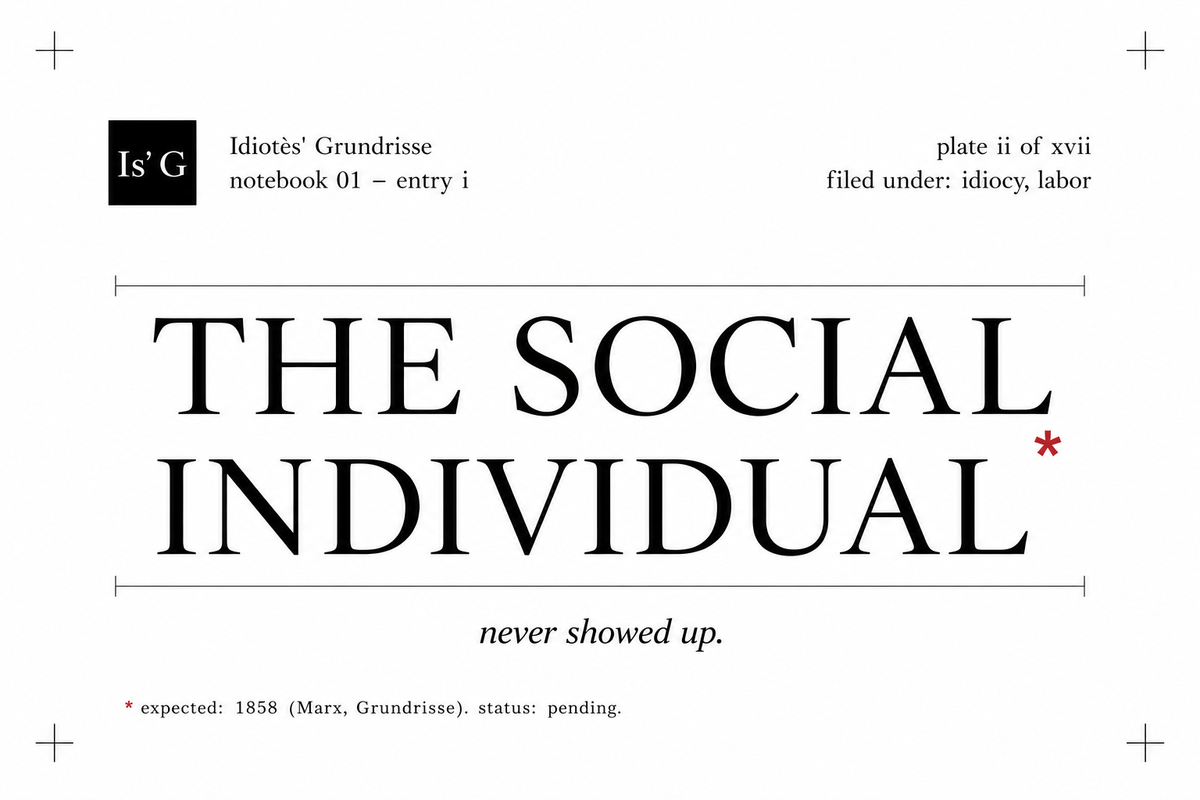
The Social Individual Never Showed Up
Notes toward a Grundrisse for the rest of us
In 1858, in a London apartment, a man with bad health and worse finances sat down to draft what would become his most important unfinished book. He called it nothing in particular. We call it the Grundrisse. Seven notebooks, written in fever-pitch German, full of marginalia and unresolved arguments. Marx wrote it for no one — not even himself, really. He died without publishing it. The manuscript surfaced in Moscow in the 1930s, was translated into English in 1973, and has been quietly destabilizing his more orderly works ever since.
The Grundrisse contains, among other things, the strangest and most generous thing Marx ever wrote about the future. He called it the social individual.
The argument runs roughly like this. Under early industrial capitalism, the worker is a private creature, isolated on a farm or in a craft, producing in narrow conditions, knowing only what the trade demands. Marx had a name for this: craft idiocy. Rural idiocy. He was using the word in the older Greek sense – idiōtēs, the private person, the one who sits out the public life of the city. Not a slur for low intellect. A diagnosis of withdrawal.
Industry, Marx believed, would pull the worker out of that withdrawal. Not because factory life was a good time. Because mass production would put each person inside a vast network of accumulated human knowledge — every machine a frozen drop of someone else's thought, every workplace a dense overlap of skills and dependencies. The worker would, eventually, understand themselves as social. The wealth of nations, Marx wrote, would no longer rest on the private hours of any one body but on "the development of the social individual."
It was a beautiful idea. It was also, in retrospect, slightly absurd.
The social individual was supposed to be us. We have what Marx couldn't have imagined: instant access to the accumulated thought of the species. A library of every text. A search bar over every photograph ever digitized. A corpus of every conversation a machine could be fed. By any measure he would have recognized, the conditions for the social individual have more than arrived. They have saturated the air.
And what showed up?
The idiotēs with a feed.
I don't mean this as an insult. I mean it descriptively. We produce content without belonging to a community of producers. We click on petitions without knowing our neighbors. We consume the exhaust of every revolution and commit to none of them. The volume of accessible knowledge has gone vertical; the experience of being a citizen has gone flat. Whatever the Grundrisse was sketching — that thing didn't happen. The opposite happened. The accumulated knowledge of the species is being used, at unprecedented scale, to produce a more efficient kind of private person.
Generative AI is not the cause of this. It would be flattering to ourselves to say so. The idiotēs with a feed predates the chatbot by twenty years; you can find them in early YouTube comment sections, in the first generation of bloggers who thought hot takes were a profession, in the long descent of cable news into spectacle. But generative AI is the most efficient tool yet built for that subject. A machine that produces fluent output without belonging. A worker without a workplace. A voice without a position. A thinker without thoughts.
Pause there. Without thoughts is too cheap. The machines do something — they pattern-match, they recombine, they predict the next plausible token. What they don't do is care, locate themselves, take responsibility, or owe anyone anything. They produce, in other words, exactly the kind of output the modern idiotēs is being trained to value: content in the precise sense, free of context.
This is the inversion the Grundrisse didn't see coming. Marx assumed the social individual would come from the inside out — from a worker waking up to their own embeddedness. What we got was a tool that lets the worker simulate embeddedness while remaining alone. It writes your essay, your apology, your wedding speech, your condolence note. It writes the texture of belonging without the costs of it. And in doing so, it offers a final, perfect deal to the idiotēs: you can keep your privacy, your distance, your refusal to show up — and still appear to have shown up.
The deal is the point. The deal is what this project is about.
This notebook — and this is, in the Grundrisse spirit, a notebook, not a treatise — is going to spend a long time refusing that deal. It will try to map the collision of human work and machine logic at the level where both actually live: in the texture of an ordinary day, in the structure of an ordinary feed, in what a person does for forty hours a week and how they feel on Sunday night. It will quote Marx, but also Arendt, Aristotle, and people you have never heard of who write better than the people you have.
It will not promise that AI is salvation. It will not promise that AI is apocalypse. Both of those promises are idiotēs positions — they let the speaker withdraw from the actual question, which is harder and slower: what kind of subject is being produced here, and is that the subject I want to be?
Marx wrote his notebook because he didn't know the answer yet. I am writing this one for the same reason.
The social individual never showed up. But there's no rule that says they can't.